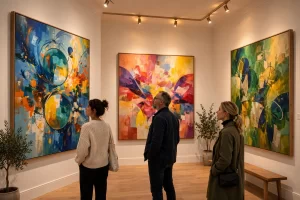
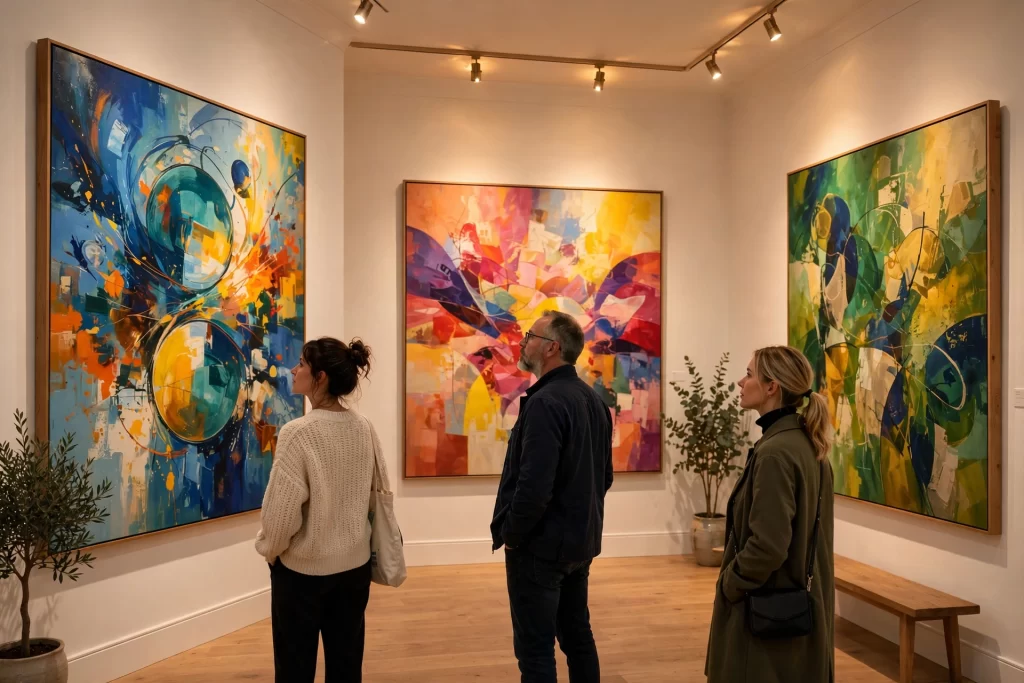
In 23 years, Philip Slein Gallery in the Central West End has almost never handed its entire space over to one artist. Usually just the front room gets the spotlight. For Edward E. Boccia, the gallery made an exception — and filled every wall with the work of a long, remarkable life.
Edward E. Boccia: An American Modernist runs October 23 through December 19 at the gallery on McPherson Avenue, and gallery owner Philip Slein calls it a landmark show. “The only thing that could be bigger than this would be at an institution,” he says.
From New Jersey to the Ghost Army to WashU
Boccia was born in New Jersey in 1921 to Italian parents. He studied at Pratt Institute and the Art Students League in New York, served in World War II as part of the famed Ghost Army, and went on to earn degrees from Columbia University. After a teaching stint in Ohio, where he brought Bauhaus ideas into the classroom, he landed in St. Louis in 1951 when Washington University hired him. He stayed on the faculty for more than 30 years, retiring in 1986 as professor emeritus.
Those who knew him as a teacher describe a demanding but generous mentor. “His way of teaching was rigorous, but also allowed people to find their own kind of fire,” says Rosa Berland, the New York-based art historian and curator who has spent years researching Boccia’s life and work. Teaching, she says, let him pass on everything he knew about making art and art history — and he knew a great deal.
Thousands of paintings, right up to the end
Boccia was astonishingly prolific. Over his lifetime he produced thousands of paintings, from small seaside scenes to monumental multi-panel works, in a style rooted in classical tradition but constantly experimenting. His canvases pull viewers into surreal, symbol-rich scenes that reward a long look. He kept painting until his death in 2012 at age 91.
“If he wasn’t sleeping or eating, he was drawing,” Slein says. “The output is amazing.”
Berland’s new book, Edward E. Boccia: Painter of Nightmares and Dreams, is the first major monograph devoted to the artist. Published by Hirmer during the exhibition’s run, it gathers dozens of images of his work — including fold-out reproductions that capture the scale of his multi-panel paintings — alongside scholarly essays and historical context.
Berland describes Boccia as a true polymath: a man who studied philosophy, theology, psychoanalysis, art history, and history, and let all of it seep into his paintings without ever making them feel like lectures. His own guidance to viewers, which she quotes in the catalog, was simple: “Don’t worry about what my pictures mean. Feel them.”
What to see at the show
The exhibition surveys more than 30 paintings across Boccia’s career. The front room is devoted to the large-scale works he’s best known for, including the nine-panel autobiographical polyptych “Eugene’s Journey” and the 2004 triptych “David’s Death,” one of his meditations on the death of his son. Further in, surreal and mythic scenes of ocean voyages and luminous figures line the walls. The final room offers a salon-style hang tracing his evolution from an early 1950s portrait to a piece painted in 2012, shortly before he died.
Look closely and you’ll spot the echoes of the artists who shaped him — Cézanne, Picasso, Magritte, Renaissance masters, and Max Beckmann, another towering figure in St. Louis art history.
A St. Louis story
Boccia’s career was also shaped by one of the city’s great patrons, Morton D. May, whose legendary collection was gifted in part to the Saint Louis Art Museum. Berland calls May his greatest patron, and St. Louis the place where everything came together: a city where he could paint, teach, raise a family, and grow.
“This is really a story of a kid from New York who found success in St. Louis,” Berland says. “St. Louis has a reputation for fostering great artists, for being great patrons of the arts.”
Together, the exhibition and the book offer a deep dive into an artist whose legacy is woven into the fabric of the St. Louis art community — and a perfect reason to spend an afternoon in the Central West End this fall.