Three years ago, Sally Haas packed up her life in Chicago and moved to St. Louis to be closer to her grandchildren. She was 69, worn out by the move, and feeling like she’d lost her spark. Her husband had a suggestion: join a gym.
Haas had never been much of a gym person — she spent years on stage as a stand-up comic, not under a barbell. But she signed up at The Edge Fitness Clubs in Shrewsbury and started cautiously, walking the treadmill and steering clear of the machines she didn’t know how to use.
A few months in, her daughter nudged her to hire a trainer. That changed everything.
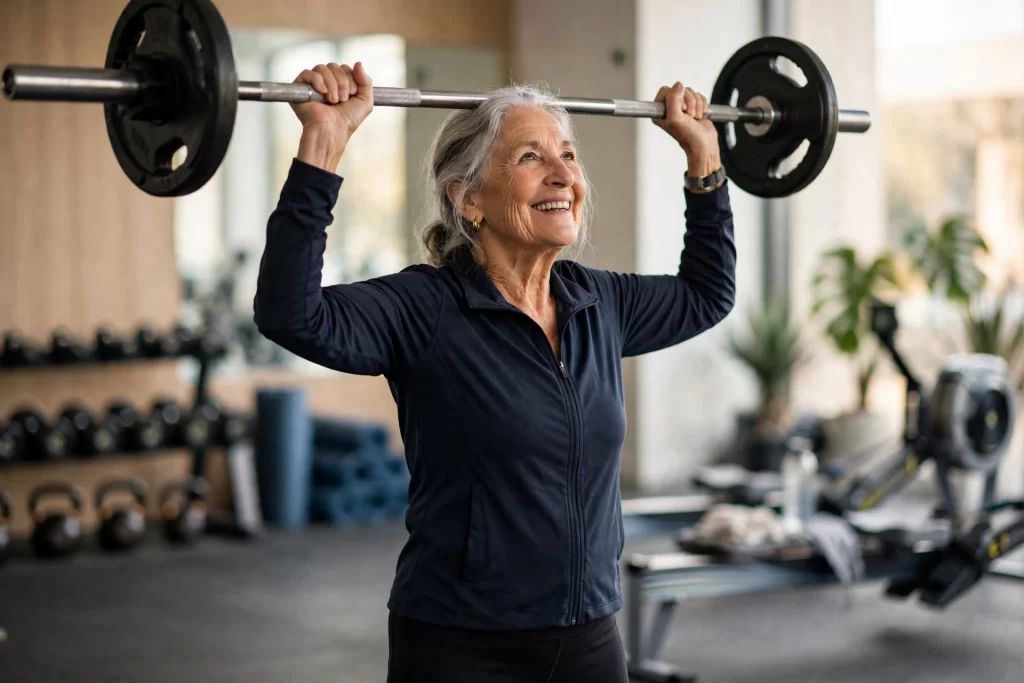
“I always set a really big goal for myself,” Haas says. Her first idea was bodybuilding — until she went to a competition and realized how much posing was involved. Powerlifting, on the other hand, looked like the movies: people stepping up and hoisting big bars overhead. She gave it a try, and she was hooked.
When her first trainer left the gym, Zach Cayer took over her program. He says most people Haas’s age wouldn’t dream of getting under a barbell, but Haas had already taken to the big compound lifts — squat, bench press, and deadlift — and wanted to go further.
Why muscle matters more as we age
You don’t have to chase a 200-pound deadlift to get something out of strength training later in life. Jill FitzGerald, a professor of physical therapy and athletic training at Saint Louis University, puts it plainly: muscle is what keeps us independent. It’s what lets us stand up from a chair, climb stairs, carry groceries, and catch ourselves when we stumble.
Muscle mass peaks somewhere around age 30 to 35, then typically slips 3 to 5 percent each decade, with the decline speeding up past 60 or 65. The encouraging part, FitzGerald says, is that older muscles still respond to training — it just takes more consistent effort, since you’re building new muscle while fighting off loss at the same time.
Haas felt the difference within months of training: muscle appearing where there hadn’t been any, energy up, mood up. She calls it a transformation from the inside out. She credits Cayer with teaching her to train safely right up to the edge — lifting until she can’t complete another rep with good form — without ever treating her like she’s fragile.
“He doesn’t treat me like I’m a grandmother, because I feel the same as I did when I was 30,” she says.
On stage again — this time with a barbell
At the 2026 USPA Tested Missouri State Championships in March, Haas won her age division, deadlifting 203 pounds, squatting 121, and bench pressing 82. The rush of performing in front of a crowd felt familiar from her comedy days — “and I didn’t even have to tell a joke,” she laughs.
She now documents her training and competitions as @GymGrannySally on Instagram and TikTok, hoping to nudge other people her age into the weight room.
How to start, at any age
Cayer’s advice for anyone new to lifting: start with a trainer, at least at first. A good first session is a movement assessment — squats, hinges, presses, pulls, and core work — to see how your body moves and which muscles are over- or underactive. From there, a program can be built around what you actually need and what you’ll actually stick with.
It’s also smart to check with your primary care doctor before starting a new exercise routine, especially if you have existing health concerns. Beyond lifting at least twice a week, FitzGerald recommends 150 minutes of moderate aerobic activity weekly, balance work at least three days a week, and enough protein in your diet — exercise sends the signal to build muscle, she explains, and nutrition supplies the materials.
Haas has rethought her eating the same way she rethought her training. “Everything I eat, I ask myself, what is this doing for me?” she says.
Asked what they most want people to know, Haas, Cayer, and FitzGerald all land in the same place: it’s never too late. Even people with significant muscle loss can rebuild it. And as Haas puts it, “If you keep reinventing yourself, life can be a lot of fun, and muscle knows no age.”