Two out-of-state landlords with big St. Louis portfolios are facing a reckoning today — and county leaders say the lasting fixes have to come from Jefferson City.
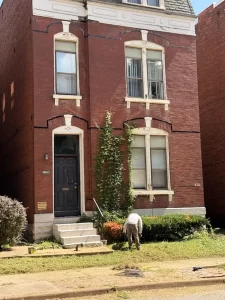
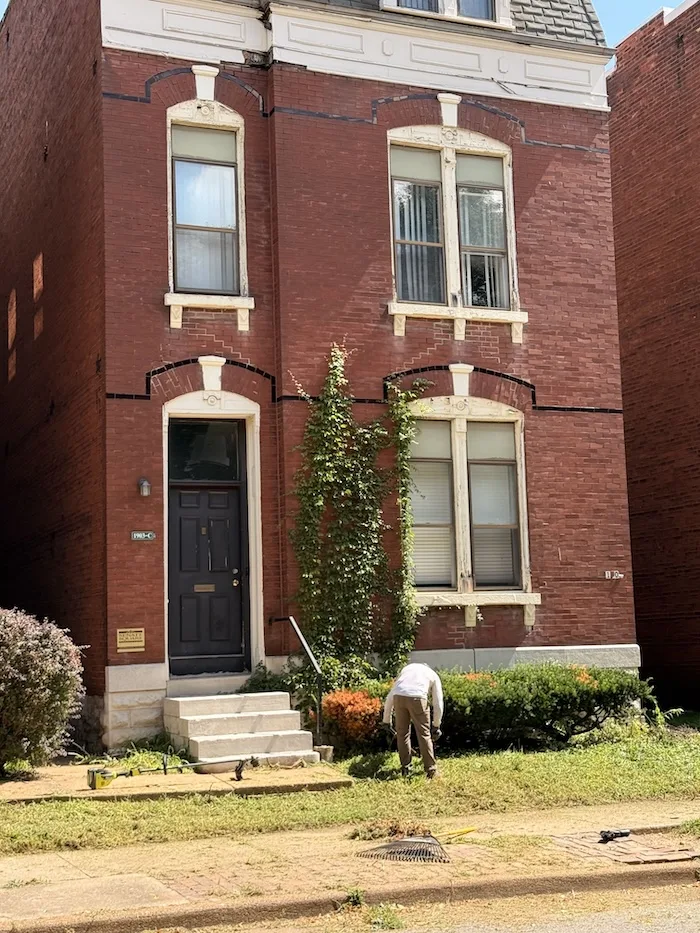
In Benton Park, the troubled Senate Square property — some 30 historic rowhouses converted to apartments that long coexisted with owner-occupied homes — heads to the auction block on the courthouse steps. Ever since an out-of-state owner took over in 2022, neighbors have complained about unsecured buildings, overgrown weeds, water leaks, mold, and structural problems. The city cited the owners back in July, but they’ve been no-shows in court.
Also today, a deadline set by St. Louis County expires for the owners of the Northern Village apartment complex in North County, who must answer for two years of code violations, overdue taxes, and unpaid utility bills. Last winter, residents went without heat and water while contending with mold, mice infestations, and sewage leaks. County Executive Sam Page has asked the council for an emergency fund to relocate roughly 150 families living there. In an October 6 letter, Page warned the owners the county would condemn the property and issue vacate orders starting October 19 — and he says a $700,000 gas bill comes due today.
The two properties have different owners, but each is controlled by opaque LLCs tracing back to out-of-state investors. The Northern Village land is held by MAZAL IN ST. LOUIS LLC, tied to Mendel Fischer, president and CEO of Florida-based TGBG Management. Senate Square sits under several LLCs, including ST. LOUIS 5 2022 — incorporated in Missouri by David Shemano — and connected to New York-based Aurox Equities. In both cases, management has been hard to reach and unresponsive.
So what can actually be done? Page says the answers live at the state level. A state law that took effect this year — specific to St. Louis County — lets the county require an LLC owner to name a real person with management control, via an affidavit listing a name and street address. But the requirement only kicks in after a firm has violated a local ordinance twice on the same parcel and the two sides reach an impasse. Page says the state could go further.
“This is really up to the state legislature,” he says. Local government can chase code violations and help people falling through the cracks, “but the regulatory environment around property ownership is state law.”
Danielle Spradley, the county executive’s regional policy strategist, describes tracking down bad owners as a game of whack-a-mole. Because state law supersedes local law on corporate ownership, counties have a narrow playbook. One option: the state could require disclosure of anyone holding more than a certain equity threshold in a property, so officials always know who to call — and who should pay. Another: requiring utility companies to give advance notice, like 30 days, before shutting off service, so paying tenants aren’t stranded when management skips the bills. The county executive has already asked for county legislation on that.
Condemnation is on the table, as the Northern Village case shows, but counties often hesitate because forcing tenants out can make a bad situation worse. That means tenants need relocation help — and in this case the county council has balked at funding it. Pairing relocation with pulling permits for uninhabitable units would keep owners from profiting off deteriorating buildings or immediately re-renting bad units to someone new. The county has also formed a task force to build a standing response as more aging apartment complexes get bought up by investment firms.
Spradley notes that bad publicity can be a powerful tool — a terse letter, a public call-out — but it’s a weak weapon when the target is an LLC nobody’s heard of. Stronger state ownership-disclosure rules would give that bully pulpit real force.
Rachel Hurtado, a tenant organizing lead with ArchCity Defenders who has worked closely with Northern Village residents, says the focus should be on personal accountability. “These are real human beings behind these LLCs,” she says, “and they should be held personally accountable for the properties that they own.” She also backs a rental registry — requiring owners to register and obtain an occupancy permit with each new tenant. The city already adopted such a system in 2024 after an ArchCity Defenders push, but it isn’t set to go live until next year. On paper, she says, but not in enforcement. Requiring negligent landlords to compensate tenants forced to move would, in her view, be the strongest motivator to keep conditions up. In the meantime, she’s organizing tenants toward collective action: “we can’t wait around” for policy changes that may never be enforced.
This is a national pattern. In a new Princeton University Press book, “The Other Housing Crisis,” co-edited by University of Missouri–St. Louis professor Todd Swanstrom, researchers found that housing quality is worst — and landlords least responsive to repairs — in single-family homes owned by large investors. One suggested policy response: rental registries requiring landlords to disclose their full portfolios, like those in Buffalo, Syracuse, Minneapolis, and Portland — plus tying a landlord’s ability to rent new units to their track record of code violations.