
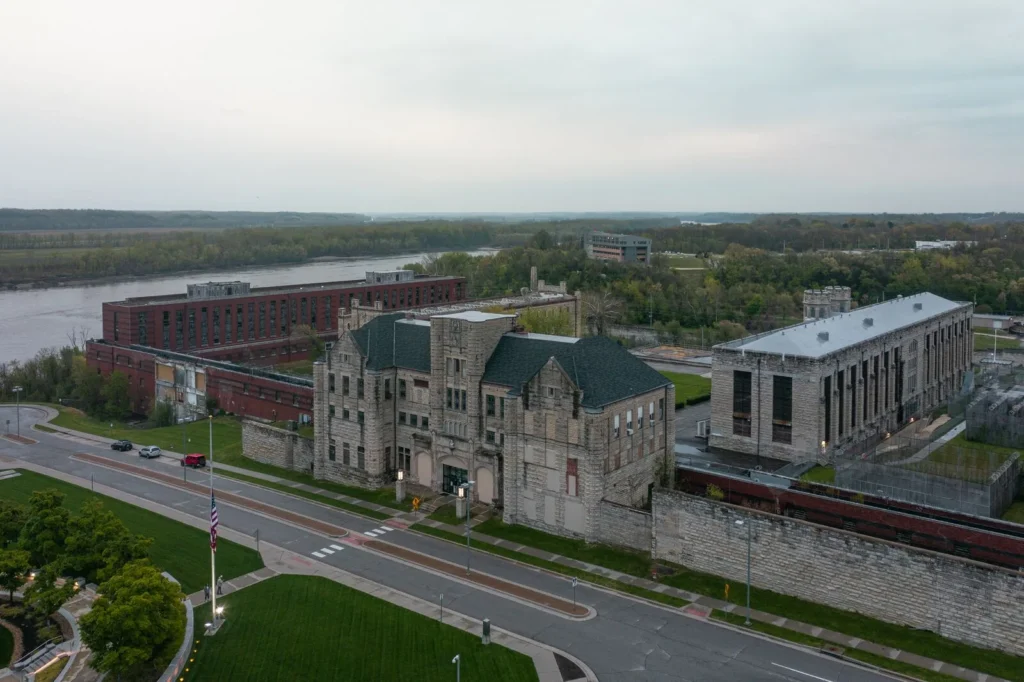
While Jefferson City is recognized as the capital of Missouri, it also boasts one of the state’s most fascinating historical sites.
The Missouri State Penitentiary, which was in operation from 1836 until 2004, is among the oldest prisons located west of the Mississippi River. Today, it provides visitors with a unique opportunity to delve into history.
“It’s a specialized attraction, but it’s deeply rooted in history, and that’s what attracts visitors,” explains Brianna Murphy, communications and film manager for Visit Jefferson City.

The Story Behind Missouri’s Capital City
Jefferson City has a rich history of its own. Situated along the Missouri River, it was selected as the state capital due to its central location and accessibility. Over the years, it developed around two main landmarks: the Capitol building and the penitentiary.
The prison had a particularly significant role. Initially built outside the city limits, it eventually became integral to Jefferson City’s identity and helped establish its status as the capital.
Its history extends far beyond what most visitors anticipate. The penitentiary welcomed its first inmate just days after the fall of the Alamo and operated for 168 years, significantly longer than many more famous institutions.
The city’s legacy continues to impact the visitor experience today.
A Deeper Look at the People Who Shaped Its History
While the penitentiary’s history includes darker moments, it is also marked by significant transformations and impacts.
One of the most notable figures associated with the prison is Sonny Liston, who later became a heavyweight boxing champion. Liston began his boxing career while incarcerated and quickly rose to international fame after his release.
Other stories reflect broader social changes. Activists like Emma Goldman and Katie Richards O’Hare were once inmates there, using their time to advocate for reform.
“The history isn’t just one-dimensional,” Murphy notes. “There are challenging times, but also stories of change and impact.”

What Visitors Can Expect
Currently, the Missouri State Penitentiary has evolved into an engaging historical attraction, featuring a range of guided tours.
Visitors can investigate several preserved housing units, including one from the Civil War era, and explore the gas chamber and other notable areas of the prison. Each tour is conducted by knowledgeable guides, many of whom share their personal insights and favorite stories during the experience.
Some guides offer even more personal stories. One long-serving guide who worked at the prison for two decades before its closure shares firsthand accounts that provide visitors with a perspective beyond mere historical facts. “They connect differently when they hear, ‘I was here. I saw this,’” says tour guide Larry Neal, explaining how these experiences enliven the narratives.